
Preschool | Daycare

Who is Montessori?
Dr. Maria Montessori (1870–1952) was an Italian physician and educator, best known for her philosophy of education and her work with children. Her educational method, the Montessori Method, is used in numerous public and private schools around the world today and is known for its emphasis on independence, hands-on learning, and nurturing a child's natural curiosity.
Montessori Curriculum
Practical Life
These activities focus on developing a child's coordination, concentration, and independence through purposeful, everyday tasks.
Sensorial
Sensorial materials are designed to refine a child's five senses by isolating and focusing on a specific quality like size, shape, color, or texture.
Language
The Montessori language curriculum moves children systematically from verbal language to written expression and reading comprehension.
Mathematics
Mathematical concepts are introduced concretely using hands-on materials before moving to abstract symbols and operations.
Culture
The cultural curriculum gives children a holistic view of the universe and their place within it.


Montessori Principles
Respect for the Child
Absorbent Mind
Sensitive Periods
Prepared Environment
Personalized Learning
Independence
Freedom of Movement and Choice
Intrinsic Motivation
Auto-Education
Prepared Environment
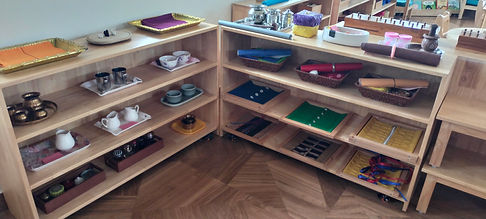
A Montessori prepared environment is a meticulously designed learning space that promotes a child's independent learning, exploration, and holistic development. It is a structured, purposeful setting where every element has a reason and a place, allowing children to learn at their own pace without constant adult intervention. Furniture and materials are scaled to the children's size, making them easy to reach and use independently. Children are encouraged to choose their own activities and work at their own pace, fostering self-discipline and decision-making skills.

Montessori vs Traditional Method
Aspect | Montessori Method | Traditional Method |
|---|---|---|
Curriculum | Flexible & Holistic: Interdisciplinary focus on academic, social, and practical life skills. | Standardized: Fixed curriculum divided into distinct subjects and sequential benchmarks. |
Age Grouping | Mixed-Age: Classrooms typically span a 3-year range (e.g., ages 3–6), fostering peer mentoring. | Same-Age: Students are grouped strictly by birth year or grade level. |
Role of Teacher | Guide: Acts as a facilitator or mentor, observing and intervening only when necessary. | Direct Instructor: Directs all learning, manages behavior, and delivers standardized lectures. |
Instruction | Self-Directed: Students choose activities based on interest and work at their own pace. | Teacher-Led: The teacher dictates the lessons, pace, and structure for the whole class. |
Assessment | Observational: Progress is tracked through teacher notes and portfolios rather than grades. | Formal: Success is measured through standardized tests, quizzes, and letter/number grades. |
Motivation | Intrinsic: Encourages a personal love of learning and internal pride. | Extrinsic: Driven by rewards, grades, and external validation. |

Education is a natural process carried out by the child and is not acquired by listening to words but by experiences in the environment.
- Dr. Maria Montessori